Life Threads and the Cost of Healing
The Night CleanerLife Threads and the Cost of Healing is the story’s governing rule for Esme’s healing power: a golden line in her vein measures a finite life, and using her ability shortens it. The line makes care legible as a personal cost rather than an unlimited gift. It shapes Esme’s choices from her first discovery of her power through the deaths she cannot prevent and the sacrifice she ultimately accepts to save Dorian.
The Thread and Its Rules
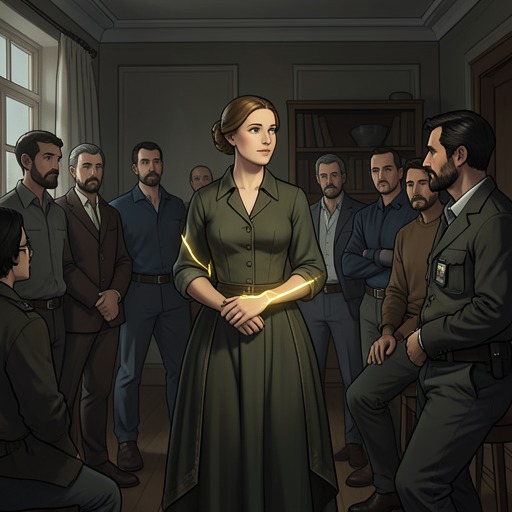
The golden mark runs through the vein down the middle of Esme’s left arm. It appeared on her sixteenth birthday, and she first discovered her healing ability after using it to save a squirrel injured by the family dog. As she and her twin brother Eli learned, every time Esme healed someone, the thread became shorter. The reduction was usually small, but its visible progress made each use a reminder that her ability had a limit.
Searching for an explanation, the twins read about The Fates: three figures associated with the beginning, duration, and ending of a person’s life. One spins the thread, another determines its length, and the third cuts it, deciding how the person dies. Their reading also distinguished mortal life from the condition of The gods, whose golden blood, or ichor, meant their threads could not be cut. Esme and Eli could not establish every detail of the lore, but they believed the line’s disappearance would mean that something was seriously wrong. They also feared that each healing might cost Esme years, not merely shorten the mark by a negligible amount.
The thread is both a supernatural rule and a practical presence in Esme’s daily life. In the present-day scenes, she notices a bright gold glint on her arm and remembers to conceal it. She covers the line with makeup; by then, it extends to about half the length of her forearm. The visible change records recent use of her power and forces a private danger into ordinary routines. The line can be hidden from other people, but hiding it does not reverse its shortening.
Healing, Consent, and Loss
The rule first becomes a moral crisis around Eli. As leukemia brings him near death, Esme pleads to heal him, knowing she has the power to do so. He refuses. Their disagreement has recurred during his illness, and Esme understands that healing him without his permission would damage the trust between them. Her willingness to accept a shorter life with her brother does not settle the question for him: he believes accepting the treatment could take away the future she still has the chance to live.
Eli’s refusal turns the life thread from a private measure of Esme’s survival into a boundary between two people who love each other. In their final time together, he holds her arm where the faint gold line runs over her vein. Esme knows through their bond that his own thread is about to be cut. When that bond breaks and his arm falls away, the limit of healing becomes absolute: her power cannot compel another person to accept help, nor can love guarantee that a life can be saved. For Esme, the experience makes the gift seem like a curse, because its cost cannot secure the survival of the person she most wants to protect.
The same cost follows Esme into her work with the gifted. After Rose and Draco saved her from a man who had threatened her at the hospital, she felt indebted to them, though she did not express that debt aloud. Later, when Charles and Leon arrived at the hospital close to death, she healed both. She also healed Charles’s spine so that he could use his legs again. Esme kept her involvement secret from Hero Society, as far as she could tell, and did not seek recognition. She accepted that the healings might have taken years from her life and remained willing to do them again. These choices show that the shortening thread does not make her stop helping; it makes each act of help a decision made with its cost in view.
The Thread in Other Lives
The story places Esme’s finite life alongside Dorian’s means of maintaining immortality. To remain immortal, he undergoes a blood infusion that mixes his gold-tinged blood with donated blood from a man with god-given powers. The process takes hours and leaves Dorian bedridden until it is complete. He has used donations found among people on the streets, but by this point the hospital has a sufficient supply that he no longer needs to collect blood himself. His method relies on another person’s gifted blood; Esme’s healing, by contrast, spends the healer’s own remaining life. The comparison distinguishes continued immortality maintained through transfusion from power exercised at a direct, personal cost.
Dorian also notices the thread on Esme’s arm while she sleeps and observes that it is shorter than it had been a few days earlier. He infers that she has healed someone recently, guessing it may have been her mother, who seems to be coming down with an illness. The scene makes the thread a trace that another person can read even when Esme conceals it in public. It also emphasizes that the cost accumulates across acts of care, including healing that may not be announced or acknowledged.
The Final Choice and Its Meaning
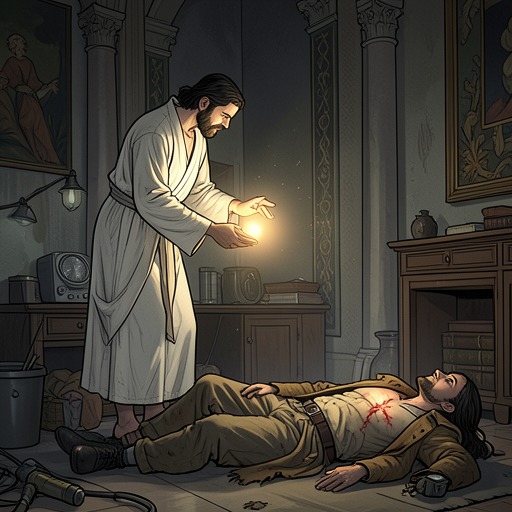
The rule reaches its starkest consequence when Dorian lies close to death. Esme removes the metal bar in his chest and uses her power to heal him. As her hands glow gold over the wound, she sees the color draining rapidly from the line in her vein and realizes that saving him will consume what remains of her life. She proceeds, accepting that she cannot live in a world without him even though he might survive without her.
Afterward, Esme’s power is gone along with her remaining years of life, while Dorian is healed and able to sit up and cradle her. The outcome completes the exchange that has governed her power all along: healing preserves another life by diminishing the healer’s. Set against Eli’s refusal, Esme’s final choice is not a universal answer to the ethics of treatment, but a different decision made in a different relationship and circumstance. The golden thread gives that distinction a visible form. It marks the possibility of saving someone, the limits of what healing can promise, and the life Esme knowingly spends when she chooses to save Dorian.